Recently, the Jiangsu Key Laboratory of Immunity and Metabolism of our university has published a research paper titled "Faecalibaculum rodentium Alleviates Ionizing Radiation-Induced Damage in Mice by Improving Intestinal Integrity and Hematopoiesis via Its Metabolite Butyrate" in Advanced Science—a Journal Citation Reports (JCR) Q1 journal of the Chinese Academy of Sciences (CAS). Xuzhou Medical University is the first affiliated unit of this article. Professor Yang Jing, Lecturer Pan Yuchen, and Chief Technologist Chen Xin from Jinhua Hospital Affiliated to Zhejiang University School of Medicine are the corresponding authors, while Zhu Hanyong, a master’s student of our university, is the first author of the article. This research work was supported by projects including the National Natural Science Foundation of China, the Natural Science Foundation of Jiangsu Province, the Xuzhou Science and Technology Plan Project, the "Jie Bang Gua Shuai" Program of Xuzhou Medical University, and the Talent Initiation Fund of Xuzhou Medical University.
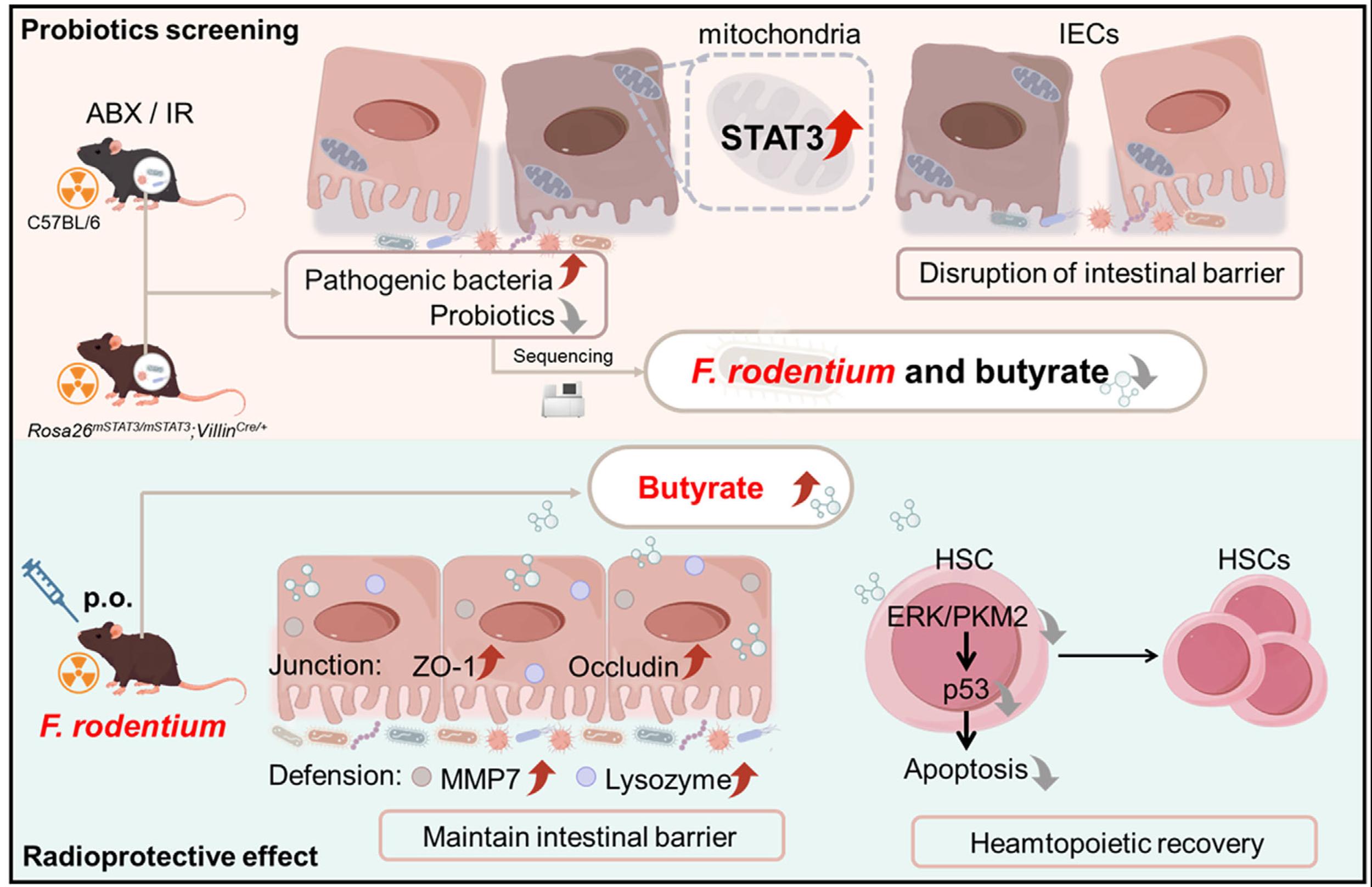
Ionizing radiation can cause severe damage to the body, especially to the intestinal tract and hematopoietic system. Although the gut microbiota plays a key role in alleviating radiation-induced damage, the specific bacterial species that exert the core protective effect and their underlying molecular mechanisms remain unclear. This study found that Faecalibaculum rodentium—a probiotic strain screened through multiple models—can alleviate ionizing radiation-induced damage in mice. Mechanistically, Faecalibaculum rodentium can promote the production of butyrate through both direct and indirect effects: on the one hand, butyrate maintains the integrity of the intestinal epithelium by upregulating the levels of tight junction proteins (such as ZO-1 and Occludin) and defensins; on the other hand, butyrate can inhibit p53-mediated apoptosis in hematopoietic stem cells by maintaining ERK-dependent nuclear translocation of PKM2. Through the aforementioned effects, Faecalibaculum rodentium and its metabolite (butyrate) can ultimately alleviate ionizing radiation-induced intestinal and bone marrow damage, and reduce the mortality rate of mice. This study provides a solid theoretical basis for the treatment of ionizing radiation-induced damage, offers new insights into ionizing radiation protection strategies, and also provides data support for the clinical application of probiotics.
Original Link: https://pubmed.ncbi.nlm.nih.gov/41082369/
First review: Li Li. Second review: Wang Wenshi. Third review: Han Hongliu.

