Recently, researchers from Jiangsu Key Laboratory of Immunity and Metabolism & Jiangsu International Joint Laboratory of Immunity and Metabolism of our university have published a latest research paper entitled A commensal protozoan exacerbates acetaminophen-induced liver injury by producing free sphingosine online in Gut Microbes (CAS Zone 1 Top Journal, IF=11.0). Xuzhou Medical University serves as the first affiliation of the paper. Yan Xiaoqing (faculty of the Second Clinical Medical College), Shen Yusi (postgraduate student of Jiangsu Key Laboratory of Immunity and Metabolism), and Sun Qian (attending physician of Xuzhou Municipal Hospital Affiliated to Xuzhou Medical University) are the co-first authors. Associate Professor Kou Yanbo and Professor Wang Yugang from Jiangsu Key Laboratory of Immunity and Metabolism are the corresponding authors. This research was supported by the National Natural Science Foundation of China, Jiangsu Provincial Natural Science Foundation, as well as the "Listing and Leading" Project and the Basic Medical Discipline Backbone Teacher Innovation Capacity Improvement Cultivation Program of Xuzhou Medical University.
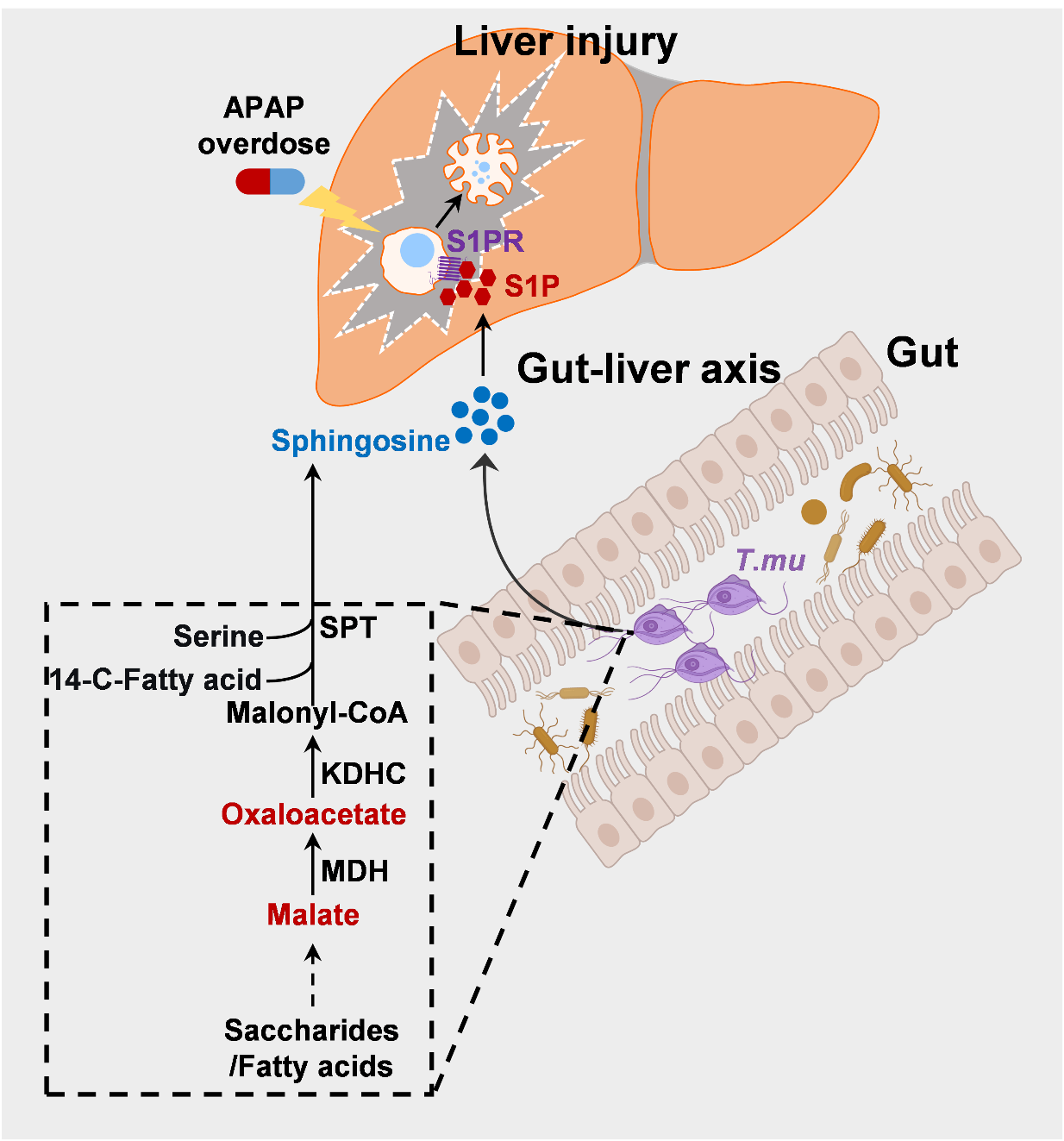
It is an established fact that the gut microbiota affects host diseases and their prognosis. However, the physiological and pathological roles of intestinal commensal protozoa, a long-neglected component of the intestinal microecosystem, remain poorly understood. In this study, the researchers found that Tritrichomonas musculis (T. mu), a commensal intestinal protozoan, increases host susceptibility to drug-induced liver injury by producing free sphingosine in a Sphingosine-SPHK1/2-S1P-S1PR axis-dependent manner. In addition, through metabolic flux tracing analysis, a novel pattern of in-vivo sphingosine synthesis was identified: instead of directly utilizing palmitic acid to provide long-chain carbon skeletons, T. mu synthesizes sphingosine by using oxaloacetic acid (potentially derived from the glyoxylate cycle) as a two-carbon unit donor. These findings not only deepen the understanding of how the gut microbiota (especially the long-overlooked intestinal commensal protozoa) affects extraintestinal diseases via the "gut-distal organ axis", but also unveil a fragment of the unique metabolic pathways of intestinal commensal protozoa.
In recent years, oriented by major national and local demands and focusing on immunity and metabolism as well as the interaction between intestinal microecology and hosts, Jiangsu Key Laboratory of Immunity and Metabolism has carried out a series of basic and applied research projects on major diseases. The laboratory’s research achievements have been published in prestigious academic journals including PNAS, Hepatology, Journal of Clinical Investigation, Microbiome, Cancer Research, Cell Reports Medicine, Theranostics, Gut Microbes, JHEP Reports, Advanced Science, Nature Communications and Cell Host & Microbe, with more than 10 national invention patents authorized.
Original Article Link: https://www.tandfonline.com/doi/full/10.1080/19490976.2026.2681811
(First Review: Li Li; Second Review: Wang Wenshi; Third Review: Han Hongliu)

