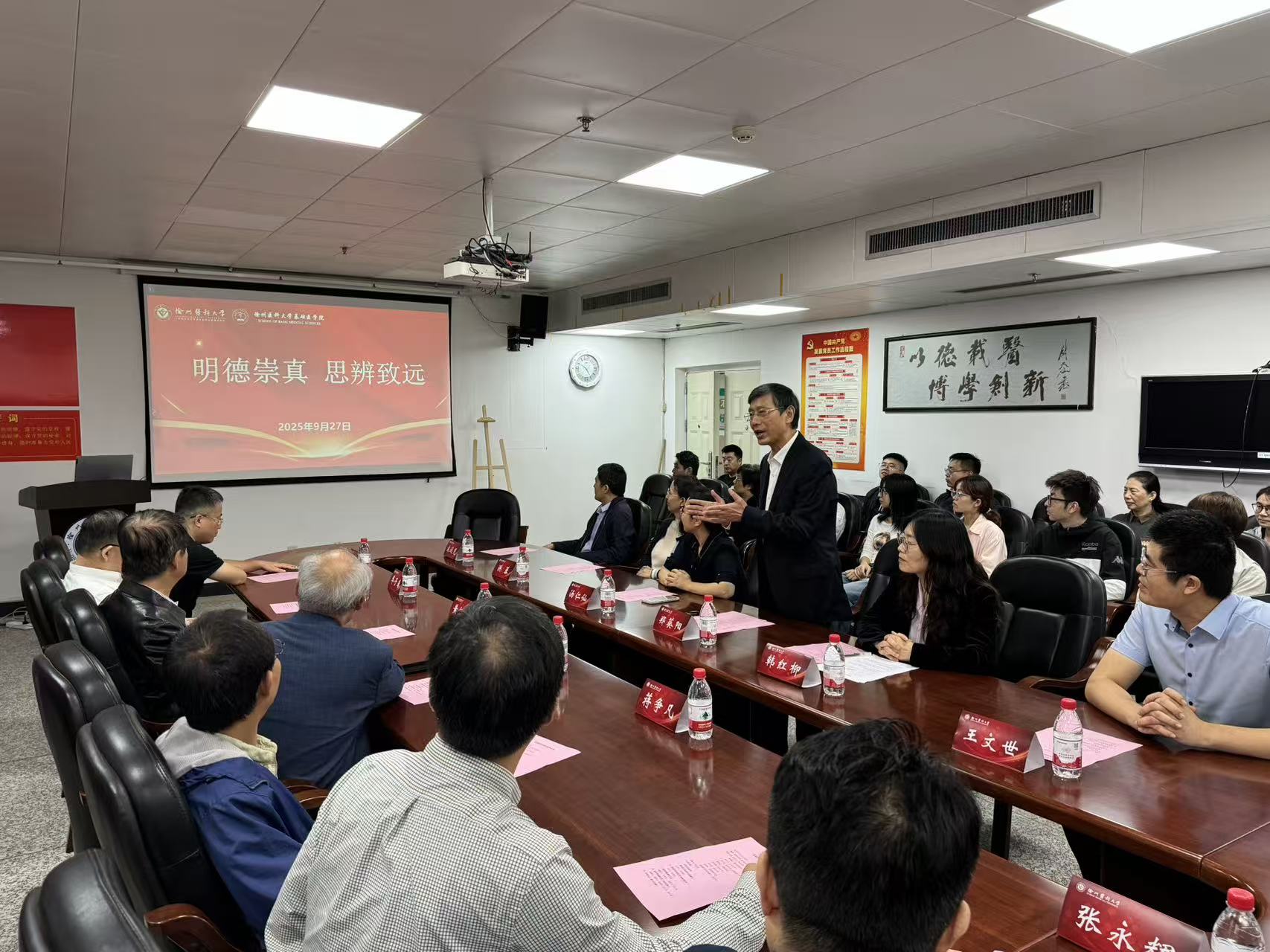
On September 27, the inaugural unveiling ceremony for the motto of the School of Basic Medical Sciences was successfully held on the third floor of the Main Teaching Building. Attendees included Professor Zhang Xueguang, Honorary President of the Jiangsu Society of Immunology; Professor Huang Xufeng from the University of Wollongong, Australia; Professor Jiang Zhengfan from Peking University; Professor Hua Zichun from Nanjing University; Professor Zhang Xiaoming from the Chinese Academy of Sciences; Professor Zhang Yonghui and Professor Liu Wanli from Tsinghua University; former President of Xuzhou Medical University, Professor Zheng Kuiyang; members of the School of Basic Medical Sciences’s leadership team; as well as faculty and student representatives. The ceremony was hosted by Han Hongliu, Party Secretary of the School of Basic Medical Sciences.
At the event, Professor Zheng Kuiyang provided a detailed interpretation of the connotation of the School of Basic Medical Sciences’s motto, “Pursue Truth through Reflection, Embrace Virtue in Quest for Knowledge”. Drawing from the classical origins of the motto, the school’s educational philosophy, disciplinary characteristics, and talent cultivation objectives, he elaborated on the spiritual essence and value pursuit embodied in the motto, offering those present a deeper understanding. Professor Zhang Xueguang introduced the symbolism behind the calligraphy he inscribed for the motto. From the perspective of font design style and cultural origins, he analyzed how the choice of calligraphy aligns with the connotation of the motto, ensuring that the motto not only conveys spiritual strength in its content but also carries cultural depth in its visual presentation, allowing faculty and students to appreciate the thoughtful craftsmanship behind its design.
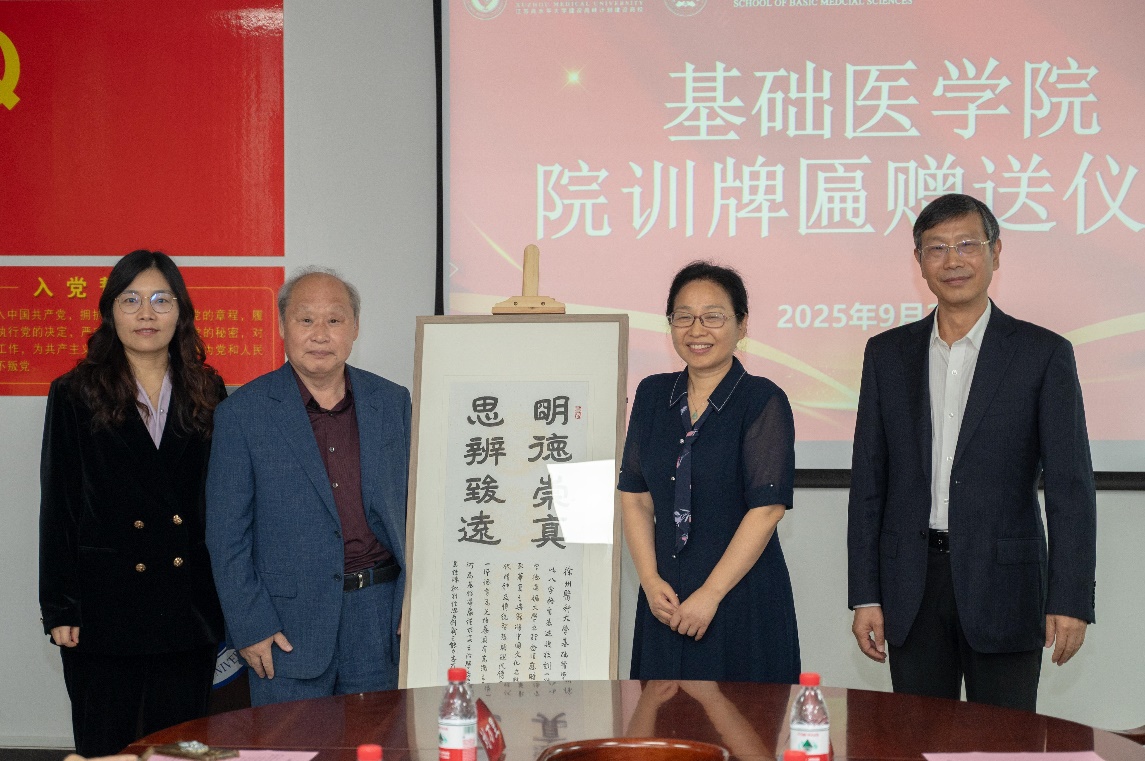
Amidst the anticipation of all attendees, the plaque presentation ceremony proceeded smoothly. As the presenter, Professor Zhang Xueguang solemnly handed over the motto plaque, which carries the spirit and aspirations of the School, to Professor Tang Renxian, Dean of the School of Basic Medical Sciences. This gesture symbolized heartfelt expectations and well-wishes for the development of the School of Basic Medical Sciences, reflecting the strong support from various parties for its growth.
Following the presentation, Professors Zhang Xueguang, Zheng Kuiyang, Tang Renxian, and Han Hongliu jointly unveiled the motto plaque. As the bright red curtain slowly descended and the motto was officially revealed, warm applause filled the venue. This moment marked a significant step forward in the cultural development of the School of Basic Medical Sciences, and the motto will serve as a spiritual banner inspiring all faculty and students to forge ahead. The atmosphere was vibrant, with faculty and students expressing their commitment to upholding the motto as their guide, dedicating themselves to their roles, studying diligently, and working actively to contribute to the development of the School of Basic Medical Sciences.
The motto of the School of Basic Medical Sciences at Xuzhou Medical University, “Pursue Truth through Reflection, Embrace Virtue in Quest for Knowledge” is expressed in an eight-character maxim, consistent with the university’s motto. It incorporates the character “Virtue” from the university’s motto, aligning with the principles of higher education and meeting the demands of the times. Drawing from classical Chinese texts, it integrates the essence of Chinese culture with the spirit of the era, merging traditional wisdom with modern heritage. This motto represents the shared values and behavioral principles of the faculty and students of the School of Basic Medical Sciences, forming a spiritual core characterized by “guidance, cohesion, heritage, and identity.” It is believed that under the guidance of the motto spirit, the School of Basic Medical Sciences will achieve even more outstanding results in education and teaching, talent cultivation, scientific research, and social services.

(First Review: Yang Xinyuan, Second Review: Tang Renxian, Third Review: Han Hongliu)

