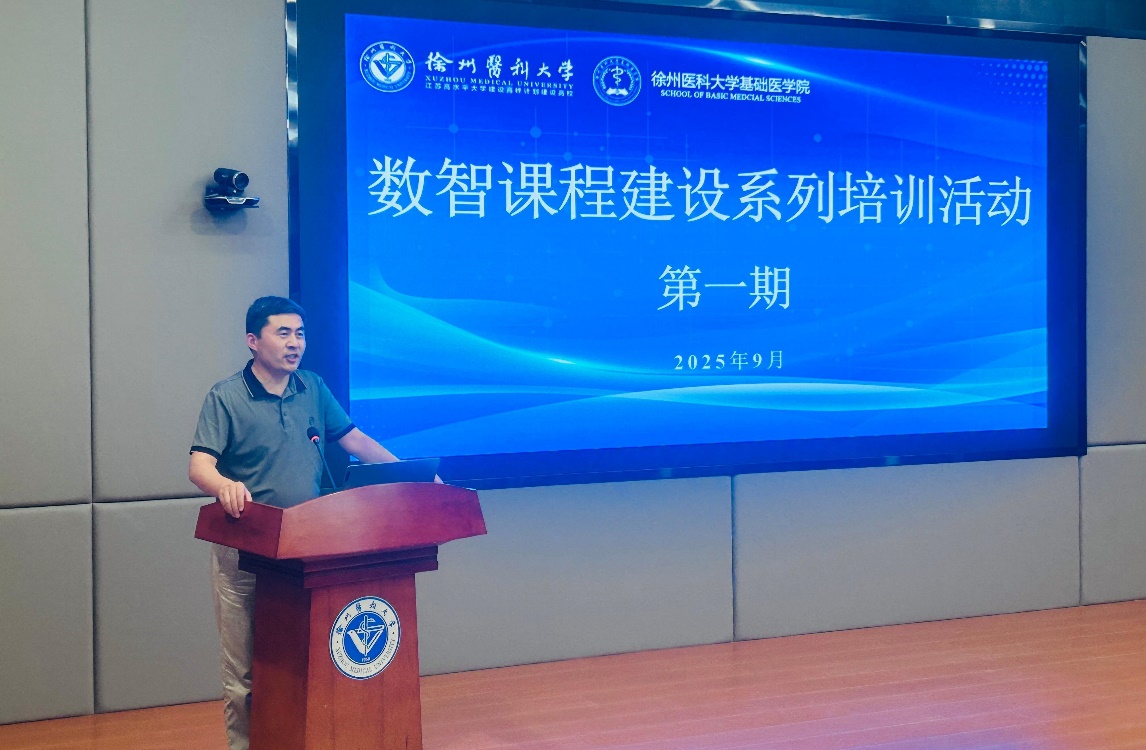
To promote the deep integration of digital-intelligent technologies with basic medical education and enhance faculty's digital teaching capabilities, the School of Basic Medical Sciences successfully held the first training session in its series on digital-intelligent course development on the afternoon of September 24. The event took place in Meeting Room 101 of the Administration Building and was attended by school leaders, all young faculty members, key teachers from various teaching and research departments, and relevant staff. The session was hosted by Vice Dean Song Yuanjian.
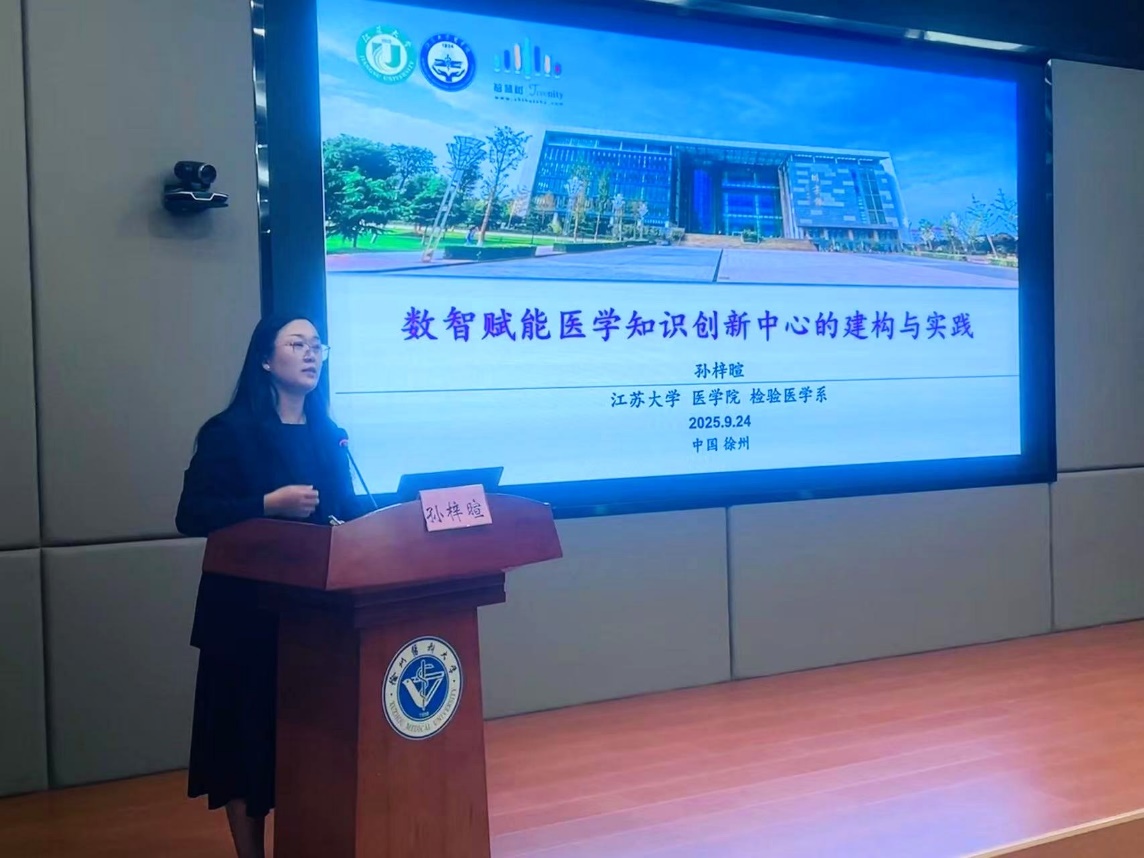
Associate Professor Sun Zixuan, Deputy Director of the Department of Laboratory Medicine at Jiangsu University, delivered a presentation titled "Constructing and Practicing a Digital-Intelligent Medical Knowledge Innovation Center." Using a national-level first-class undergraduate course she oversees as an example, she demonstrated how the knowledge innovation center bridges undergraduate and graduate curricula and integrates teaching with research. She emphasized the need for educators to shift from being "knowledge transmitters" to "collaborative mentors," focusing on cultivating students' comprehensive abilities. In the practical application segment, she highlighted innovative approaches to blended intelligent teaching: first, co-creating courses with students and promoting self-directed learning; second, integrating science and education to enable "peer mentoring"; and third, skillfully embedding ideological and political education to enrich its connotation. Additionally, she elaborated on how online teaching platforms can capture student learning data, visualize their mastery of key concepts, and provide support for personalized teaching, offering attendees replicable and actionable pathways for digital-intelligent course development.
Associate Professor Sun Shen, Deputy Director of the Department of Histology and Embryology at the School of Basic Medical Sciences, delivered a presentation titled "Organizing for Transformation and Charting a Path Forward: Toward a New Digital-Intelligent Ecosystem in Basic Medical Education." Aligning with the school's "Four-Early Education" philosophy and addressing the key challenges in traditional teaching—such as "knowledge silos," "low teaching efficiency," and "difficulty in personalized evaluation"—she shared practical approaches for the digital-intelligent transformation of basic medical education. She encouraged all faculty to participate in the development efforts, bridge interdisciplinary knowledge points, establish five distinctive teaching reform modules, and advance the implementation of digital-intelligent education in basic medicine.
Vice Dean Song Yuanjian emphasized that basic medicine serves as the "cornerstone" of medical talent cultivation, and its digital-intelligent transformation directly impacts the quality of talent development across subsequent disciplines. He noted that the training content provided a clear pathway for the school's digital-intelligent course development and encouraged faculty to actively break free from traditional teaching paradigms, explore integration points for digital-intelligent technologies in core courses, and effectively translate the training outcomes into teaching practices.
The School of Basic Medical Sciences will continue to focus on "enhancing teaching quality and serving talent cultivation," steadily advancing subsequent training efforts to support the implementation of the educational digitalization strategy within the school and contribute to nurturing high-caliber medical professionals suited to the demands of the new era.

(First Review: Song Yuanjian, Second Review: Tang Renxian, Third Review: Han Hongliu)

