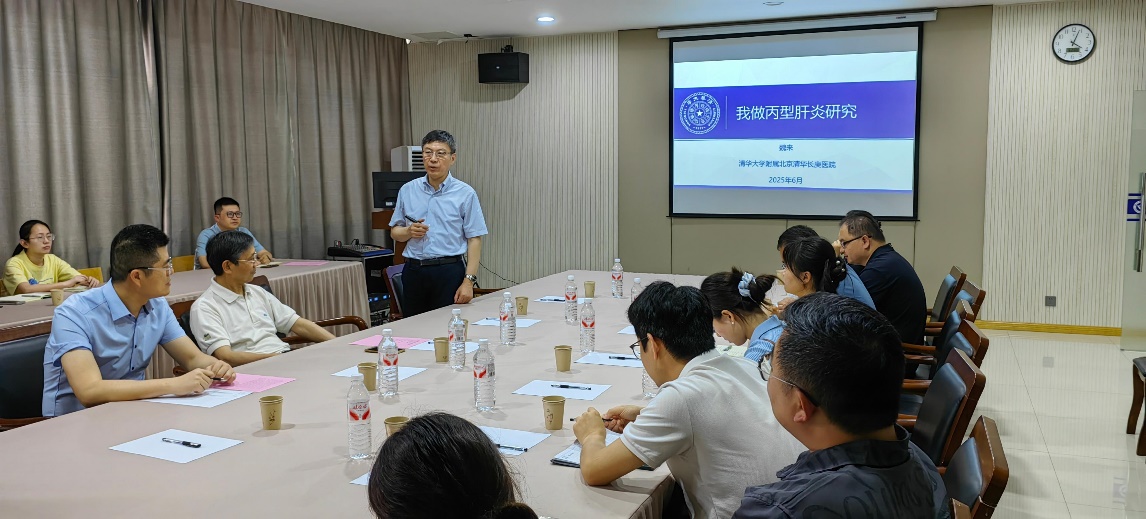
To deepen scientific research collaboration and enhance the research innovation capabilities of faculty and students, on June 21, 2025, Professor Wei Lai, an outstanding alumnus from the class of 1978, was invited back to his alma mater for an academic exchange. Over 50 participants, including Professor Zheng Kuiyang from the Jiangsu Key Laboratory of Immunity and Metabolism, Professor Tang Renxian, Dean of the School of Basic Medical Sciences, young faculty members, and graduate students, gathered to attend this academic feast. The session was hosted by Professor Wang Wenshi, Vice Dean of the School of Basic Medical Sciences.
Professor Wei Lai has achieved remarkable academic accomplishments. He currently serves as Vice President of Beijing Tsinghua Changgung Hospital affiliated with Tsinghua University and Director of the Hepatobiliary and Pancreatic Center. He also holds key positions such as Honorary Chairperson of the Chinese Society of Hepatology, Chinese Medical Association, and Member of the World Health Organization (WHO) Expert Committee on Viral Hepatitis Prevention, Control Strategies, and Technologies. As the former President of the Asia-Pacific Association for the Study of the Liver and Chairperson of the Sixth Committee of the Chinese Society of Hepatology, Chinese Medical Association, he has led major national scientific and technological projects focusing on chronic hepatitis C and fatty liver disease. Additionally, he serves as an expert evaluator for new drug reviews in the fields of viral hepatitis, fatty liver disease, and rare liver diseases at the national level. Furthermore, he holds editorial roles as Associate Editor or Editorial Board Member for several internationally renowned journals, wielding significant influence in the field of liver disease research.
Under the title "My Hepatitis C Research Journey," Professor Wei comprehensively shared his exploratory path in hepatitis C research with faculty and students. During his presentation, he used vivid and accessible language to explain why he chose hepatitis C—a disease that posed severe harm to China three decades ago—as a key research focus. He elaborated on how he led his research team to identify scientific questions, conduct research endeavors, and translate findings into clinical diagnosis and treatment applications, making outstanding contributions to hepatitis C prevention and control. His talk vividly illustrated the profound sense of mission and dedication of a scientist to his country and field. During the academic exchange session, three young faculty members presented their current research work on liver diseases and sought Professor Wei's advice on challenges encountered in their studies. Professor Wei engaged in thoughtful discussions and provided detailed answers to each inquiry.
Subsequently, Professor Wei Lai visited the university's history museum, gaining an in-depth understanding of the institution's development journey, campus cultural characteristics, and scientific research progress. He highly commended the achievements made by the university in its pursuit of becoming a high-level medical institution.
This event not only provided faculty and students with deeper insights into the clinical research dynamics of liver diseases and clarified pathways for translating research outcomes but also broadened their academic horizons, injecting new momentum into future scientific research exchanges, collaborations, and innovations.

 (First Review: Yang Le, Second Review: Wang Wenshi, Third Review: Han Hongliu)

