In order to effectively promote the review and evaluation of undergraduate education and teaching and comprehensively improve the quality of talent training, on the afternoon of May 28, Guo Dong, member of the Standing Committee of the School Party Committee and Vice President, led a team to the School of Life Sciences to conduct a special survey on the review and evaluation of undergraduate education and teaching. Wang Feng, member of the Standing Committee of the School Party Committee and Secretary of the Discipline Inspection Commission, Gao Can, Dean of the School of Life Sciences, Li Chong, Secretary of the General Party Branch, Liu Yi, Vice Dean, as well as representatives of professional teachers and heads of departments attended the research symposium. The symposium was chaired by Yan Jingzhi, deputy director of the Academic Affairs Office.
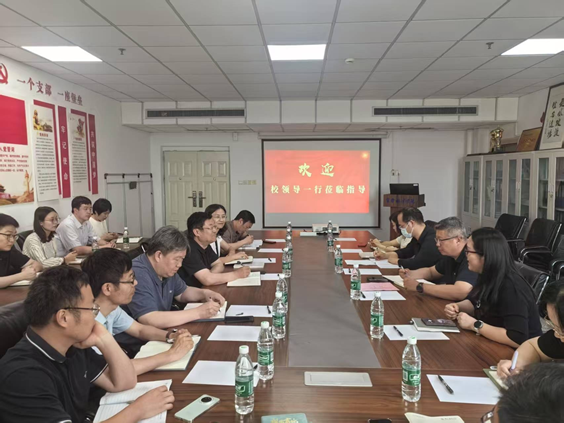
At the research meeting, Gao Can, dean of the School of Life Sciences, gave a detailed report on the overview of the School of Life Sciences, the completion of the "14th Five-Year Plan" and the progress of undergraduate education and teaching review and evaluation work, as well as existing problems and corresponding rectification measures. Wang Shilei, director of the Teaching Quality Monitoring and Evaluation Center, gave a comprehensive description of the School's construction and development in the past three years from the perspectives of core indicators and landmark achievements, and put forward constructive opinions to the School on the focus of evaluation. Yan Jingzhi and other participants conducted in-depth discussions on the key points of assessment, the integration of industry and education and the construction of teaching platforms, and the analysis of the construction of mathematical intelligence courses.
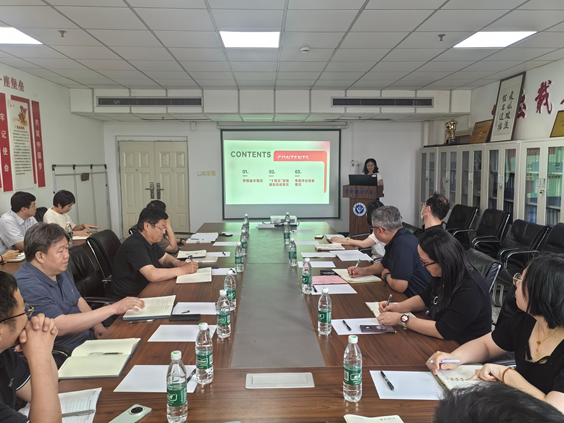
In his speech, Vice President Guo Dong fully affirmed the achievements made by the School of Life Sciences during the "14th Five-Year Plan" in terms of party building leadership and ideological and political construction, professional and curriculum construction, faculty development and talent training. In response to this review and evaluation of undergraduate education and teaching, he emphasized that it is necessary to closely focus on the core concepts of "student-centered, output-oriented, and continuous improvement" to comprehensively and systematically sort out the characteristics of undergraduate education and teaching in the School of Life Sciences and the areas for improvement, strengthen the top-level design of education and teaching, and provide stronger support for talent cultivation.
In his concluding speech, Secretary Wang Feng emphasized that the School must always adhere to the fundamental mission of "educating people for the party and educating talents for the country", lay a solid foundation for running the school, improve the quality of education and teaching, and comprehensively promote the reform and innovation of the education and teaching system. Focusing on the fundamental question of "who to train, how to train, and for whom", through in-depth discussions on education and teaching, we will comprehensively promote the optimization of the curriculum system, the innovation of teaching methods, and the reform of the talent training model. Efforts will be made to promote the cultivation of compound applied talents with "thick foundation, strong ability and high quality", continue to strengthen quality awareness and service efficiency, and strive to achieve all-round improvements in teaching quality, talent training and management level.
School of Life Sciences will take the review and evaluation of undergraduate education and teaching as an opportunity for development, and continue to deepen the closed-loop construction concept of "building a strong foundation through evaluation, improving the mechanism through evaluation, improving efficiency through evaluation, and strengthening characteristics through evaluation", focusing on improving the quality of talent training, and systematically promoting the connotation construction of the trinity of professional construction, curriculum reform, and teaching innovation. Build a quality assurance system of "goal-oriented-process monitoring-continuous improvement", and ensure the completion of all stages of evaluation tasks with high standards through an evaluation working mechanism with full participation and all-element coverage.
First Review: Wu Xiuxiang; Second Review: Liu Yi; Third Review: Li Chong

